
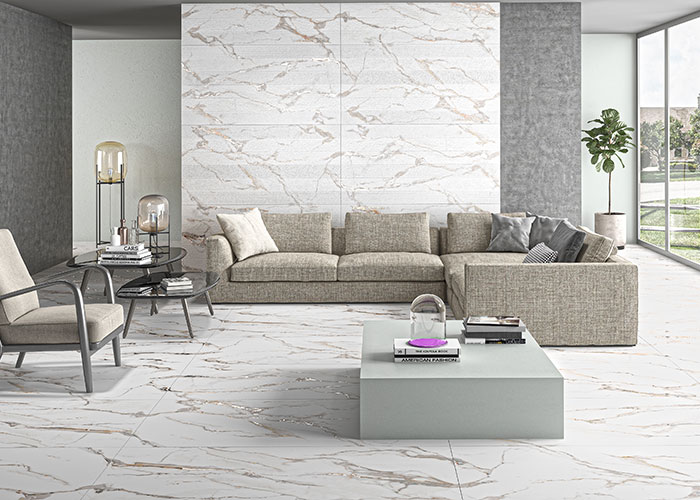
Large-format tiles—anything measuring 24″x24″ (60×60 cm) or larger are one of the most striking design choices you can make for a space. They create a seamless, modern look with fewer grout lines, making rooms feel instantly more expansive.
But behind that high-end aesthetic lies a strict technical truth: large-format tiles play by a completely different set of structural rules.
Every year, thousands of homeowners and contractors face the nightmare of cracking, tenting, or completely detached tiles just months after installation. The culprit is almost never the tile itself. It is the adhesive.
Here is the breakdown of why large tiles fail when paired with standard adhesives, and the structural science every builder needs to know.
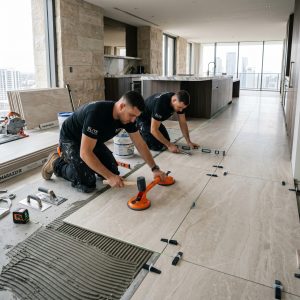
- The “Skin” Trap: Lack of Coverage and Transfer
Standard tiles (like a classic 4″x4″ ceramic) are light and highly forgiving. Standard adhesive dries via evaporation. Because the tile is small, moisture escapes easily through the surrounding grout joints.
When you place a massive 3×3-foot porcelain tile over standard thin set, a dangerous phenomenon occurs:
The Perimeter Cure: The adhesive around the very edge of the tile dries quickly because it is exposed to the air.
The Trapped Core: The adhesive deep under the center of the tile gets completely sealed off from the air. Because large porcelain tiles are completely non-porous, moisture cannot escape through the tile, and the distance to the edge is too far.
The center remains wet, weak, and skin-covered, drastically reducing the overall bond strength.
- The Physics of Heavy Lifting: Slump and Sag
A standard wall adhesive is formulated to hold lightweight materials. A single large-format porcelain tile can easily weigh 20 to 40 lbs or more.
When you apply a heavy tile to a wall or floor using standard thinset, the sheer weight of the tile pushes down, compressing the adhesive ridges beneath it. This causes slumping (on floors, leading to uneven tiles or “lippage”) or sagging (on walls, causing the tiles to slide downward before the adhesive sets).
Large-format tiles require an adhesive engineered with high green-strength and non-slump properties to mechanically hold that massive weight in place while it cures.
- Thermal Expansion: The Silent Killer
Buildings are dynamic; they breathe, settle, and shift. Furthermore, temperature changes cause materials to expand and contract.
Because a large-format tile covers a massive surface area with minimal grout joints, it acts as a rigid sheet. When subfloors naturally expand or contract, that movement creates massive shear stress beneath the tile.
[ Rigid Large Tile ] Expands/Contracts with Temp
[ Standard Adhesive ] Rigid & Brittle (Snaps under pressure)
[ Moving Substrate ] Concrete or Screed shifts naturally
Standard adhesives are rigid and brittle. When the floor shifts, the adhesive cannot absorb the stress, causing the bond to snap. The result? The tiles pop up, pull away from the substrate, or crack cleanly down the middle.
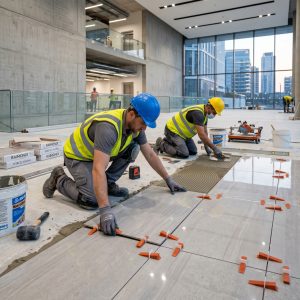
The Golden Rule of Large Format: Large tiles require high-polymer, deformable (flexible) adhesives classified to handle subfloor movement and eliminate hollow spots.
Using the wrong adhesive is a gamble where the cost of failure includes shattering expensive tile, tearing up subfloors, and paying for double the labor.
Understanding the problem is only step one. To prevent these catastrophic failures, you need an adhesive that is specifically engineered to fight trapped moisture, eliminate sag, and flex with your building’s natural movements.
Next Week: We dive into the exact chemistry required to secure large-format tiles permanently, introducing the heavy-duty standard for modern installations: Armorfix 110